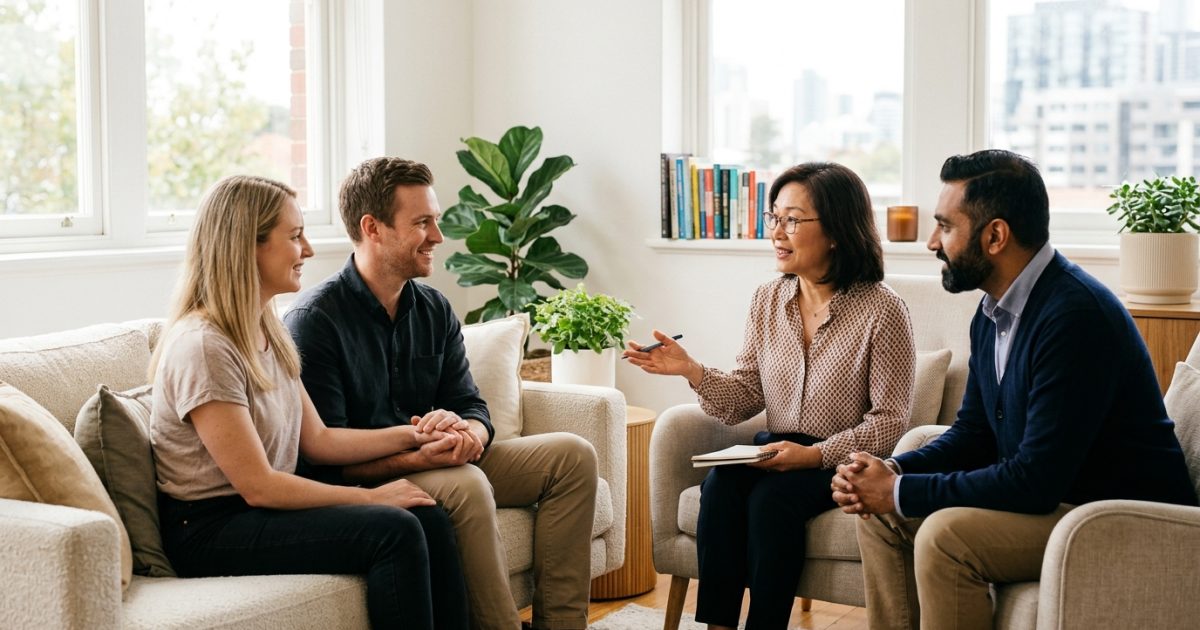

Brisbane has a solid range of relationship counsellors working across individual, couples, and family therapy, with practices spread across the inner city, inner suburbs, and online. Most are registered with the Australian Association of Relationship Counsellors (AARC) or hold membership with the Australian Counselling Association (ACA), and many bulk bill or offer Medicare rebates through a Mental Health Care Plan when linked with a GP referral.
What to Look for in a Brisbane Relationship Counsellor
Qualifications vary across practitioners. Psychologists registered with AHPRA carry the highest regulated credential, while counsellors and therapists may hold qualifications at Certificate IV through to Master’s level. For couples work specifically, look for practitioners trained in evidence-based approaches such as the Gottman Method, Emotionally Focused Therapy (EFT), or Imago Relationship Therapy. These methods have published research behind them and give you a clear framework for the sessions ahead.
Fee ranges in Brisbane sit roughly between $120 and $250 per 50-minute session for private-pay clients. If cost is a factor, some practitioners at community centres (such as Relationships Australia Queensland) offer sliding-scale fees based on household income, with sessions potentially as low as $30.
Where to Find Relationship Counsellors in Brisbane
Relationships Australia Queensland operates multiple locations across greater Brisbane, including offices in the CBD, Wynnum, Strathpine, and Ipswich. They handle couples counselling, separation support, co-parenting after divorce, and family mediation. Appointments can be booked directly through their website or by phone on 1300 364 277.
For private practitioners, Psychology Today’s Australian directory and the ACA’s Find a Counsellor tool both allow filtering by suburb, issue type, and funding method. The Gottman Institute’s referral network also lists Brisbane-based therapists who have completed Level 1 through Level 3 Gottman training, which is a useful filter if that specific method appeals to you.
Online sessions have become a standard option rather than an add-on. Many Brisbane counsellors now offer video appointments through platforms like Coviu or Zoom, which suits couples where one partner travels for work or where childcare makes in-person sessions difficult to schedule consistently.
Medicare and Funding Options
A Mental Health Care Plan from your GP gives access to Medicare rebates for sessions with a registered psychologist (currently around $137.05 per session under the Better Access initiative, as of 2024 rates). This applies to individual therapy only, not couples sessions. Couples counselling is not currently covered under Medicare, but some private health funds (including Bupa and Medibank) include a counselling or psychology benefit under extras cover. Check your specific policy before booking.

Frequently Asked Questions
How many sessions does relationship counselling usually take?
Most couples complete between six and twenty sessions depending on the issues being addressed. Short-term work focused on communication skills might wrap up in eight sessions, while longer-standing conflict patterns or post-infidelity repair typically require more time. Your counsellor should give you a rough plan after the initial assessment session.
Can I see a relationship counsellor on my own if my partner won’t attend?
Yes. Many Brisbane counsellors work with individuals on relationship issues, including preparing for difficult conversations, processing a separation, or managing conflict patterns. Some EFT and Gottman-trained therapists specifically offer individual sessions designed to complement or lay groundwork for eventual couples work.
What is the difference between a counsellor and a psychologist for relationship issues?
Psychologists hold AHPRA registration and a minimum four-year accredited degree plus supervised practice. Counsellors may hold shorter qualifications but can be highly experienced in relationship-specific work. For most couples concerns, a well-trained counsellor with specialised relationship therapy credentials is appropriate. A psychologist is more suited when mental health conditions such as depression, anxiety, or trauma are a significant part of the picture.